

Appliance Types
- Air Conditioner
- Automobile
- Chainsaw
- Circular Saw
- Dishwasher
- Drills
- Dryer
- Drywall Screw Gun
- Furnace
- Gas Fireplace
- Gas Grill
- Gas Patio Heater
- Grinder
- Heat Pump
- Impact Driver
- Impact Wrench
- Microwave
- Nailer
- Orbital Sander
- Pool Heaters
- Powerwall
- Range
- Refrigerator
- Television
- Washer
- Water Heater
Appliance Brands
- A.O. Smith
- AccuCold
- Admiral Craft
- AGA
- Airrex
- Amana
- Ambiance
- American Range
- American Standard
- American Water Heaters
- Aquacal
- Armstrong
- Asko
- Avanti
- Avenlur
- Azure
- Beko
- Bellfires
- Bertazzoni
- Blackstone
- Blaze
- Blomberg
- BlueStar
- Bosch
- Bradford White
- Bromic
- Bryant
- Cafe
- Calcana
- Capital
- Carrier
- Char-Broil
- Char-Griller
- Chrysler
- Coates
- Coleman
- Comfortmaker
- Commercial Chef
- Continental
- Cosmo
- Cove
- Crown Verity
- Dacor
- Daikin
- Danby
- Danfoss
- DaVinci
- DCS
- Deco
- DeWALT
- Ducane
- Dyna-Glo
- Dyson
- EcoSmart
- Electrolux
- Element4
- Empava
- Equator
- Eurodib
- European Home
- Everdure
- Farberware
- Fhiaba
- FibroPool
- Fire Sense
- Fisher
- FiveStar
- Flare
- Flash Furniture
- Focus
- Ford
- Forno
- Forte
- Frigidaire
- Fulgor Milano
- Gaggenau
- GE
- General Motors
- GlowBrand
- Goodman
- Grundig
- GSW
- Haier
- Hayward
- Heatstar
- Heil
- Hestan
- Hisense
- Hitachi
- Hotpoint
- iio
- Ilve
- Impecca
- Ingignia
- Insignia
- JennAir
- John Wood
- Keeprite
- Kenmore
- Kenyon
- KitchenAid
- Kucht
- La Cornue
- Lennox
- LG
- Liebherr
- Lifetime
- Lion
- Luxaire
- Lynx
- Magic Chef
- Marvel
- Maytag
- McQuay
- MicroFridge
- Midea
- Miele
- Migali
- Monogram
- Montigo
- Mr Heater
- Napoleon
- Navien
- Nexgrill
- Noritz
- Panasonic
- Patio Comforts
- Payne
- Pentair
- Perlick
- PITT
- Premier
- Raypak
- Real Fyre
- Regency
- Reliance
- Rheem
- Rinnai
- Roma
- Ruud
- Saber
- Samsung
- Schwank
- Sharp
- Smeg
- Solas
- Sony
- Spartherm
- Speed Queen
- StaRite
- State Water Heaters
- Stiebel Eltron
- SubZero
- Summerset
- Summit
- SunGlo
- SunPak
- Sunpentown
- SunStar
- Superiore
- Takagi
- TCL
- TEC
- Tempstar
- Tesla
- Thermador
- Thor Kitchen
- Toshiba
- Town and Country
- Toyota
- Traeger
- Trane
- Twin Eagles
- U-Line
- Unique
- Vaillant Group
- Valor
- Verona
- Victory
- Viessmann
- Viking
- Vizio
- Weber
- Westinghouse
- Whirlpool
- Whynter
- York
- ZLINE
Article Categories
- Air Conditioners
- Appliance Care
- Appliance News
- Dishwasher News
- Drying Machines
- Furnaces
- Gas Fireplaces
- Microwaves
- Pool Heaters
- Refrigerators
- Stoves - Ranges
- Tips and Tricks
- Washing Machines
- Water Heaters
More Articles
How Does Your Furnace and Air Conditioner Work Together to Keep You Comfortable?
Like most homeowners, you probably don't think a lot about your heating and air conditioning. You just want to keep warm in the winter and cool in the summer. But did you know that in the best HVAC systems your air conditioner and furnace actually work together to create a comfortable environment year-round?
How Does An HVAC System Work?
HVAC, a commonly used term in the heating and cooling industry, stands for "heating, ventilation, and air conditioning." These functions are often combined into one system in today's modern homes and buildings. The goal of an HVAC system is to provide thermal comfort and acceptable indoor air quality. All heating and cooling systems have three basic components:
1) A piece of equipment to both remove and add heat to the air,
2) A means of distributing that air throughout the home, and
3) A control device to regulate the temperature.
Both the cooled air from a central air conditioner and warmed air from the furnace often use the same distribution and control systems.
Although an HVAC system may seem complicated, breaking the system down into its components will help simplify things. Let's begin with the air conditioner.
Air Conditioning. An air conditioner makes your home cooler by drawing heat energy out of the house and transferring that heat to the outdoors through the AC system. The most common residential central air conditioner is called a "split-system." An outdoor metal cabinet (usually placed on a concrete slab next to the foundation) contains the condenser, compressor, and condenser fan; an indoor cabinet contains the evaporator. This indoor cabinet is part of the furnace that is typically adjacent to a basement wall.
The compressor pumps a heat transfer fluid, typically Freon refrigerant, between the evaporator and the condenser. The liquid refrigerant evaporates in the indoor evaporator coil, pulling heat out of indoor air. The air handler, or blower, in the furnace is used to blow the cooled air through the home duct system. When the blower turns on, it draws room air from various parts of the house through return air ducts. The air is then pulled through a filter to mitigate dust, lint, and pollutants. Air conditioners also remove moisture from the air resulting in a cool, dry home.
Heating. The furnace that is used to pump cooled air throughout your home in the summer heats your home in the winter. Whereas an air conditioner is powered by electricity, a furnace is typically fueled by natural gas. A home furnace is divided into three parts:
1) Burner, heat exchanger, vent and draft inducer
2) Safety devices and controls
3) Blower
All of these parts work together to keep the furnace running efficiently.
The heating process begins when the furnace combines air with fuel and an electronic igniter sparks the mixture. Hot gas then begins to rise through the heat exchanger positioned above the burner and heats the air which is circulated throughout the house. An electric fan situated inside the furnace pulls in air which comes through a large grill typically located on the main floor in the house or several individual grills located throughout the house. Before the air reaches the furnace, it goes through the furnace filter to remove dust and other particulate matter. The exchanger then heats the air very quickly as a result of high temperature flue gas. The hot air is forced out of the furnace and through the duct-work into your home's indoor spaces. The resulting flue gases that are used to create the heat are vented through vent piping and discharged through the outside wall or roof.
Ventilation. The best HVAC systems provide proper ventilation in your home for a comfortable and healthy environment. Ventilation is a combination of processes for exchanging or replacing air in a confined space. Natural ventilation is when air enters your home through doors, windows, skylights, etc. Mechanical ventilation, with devices such as exhaust fans, exhaust air out of your house in certain locations while fresh air enters through doors, windows and your wall. However, the HVAC system uses the air ducts to provide a balanced system of airflow throughout your home. Other more balanced ventilation system called a HRV (Heat Recovery Ventilator) or ERV (Energy Recovery Ventilator) draw in outside air and exhaust room air through a system that exchanges heat. These system are great for newer more efficient homes that have good windows, doors and insulation. The result is efficient ventilation control and oxygen replenishment, as well as removal of moisture, odors, smoke, heat, dust, airborne bacteria, carbon dioxide, and other gases.
The Thermostat Controls it All. The Brain Behind Your HVAC Equipment
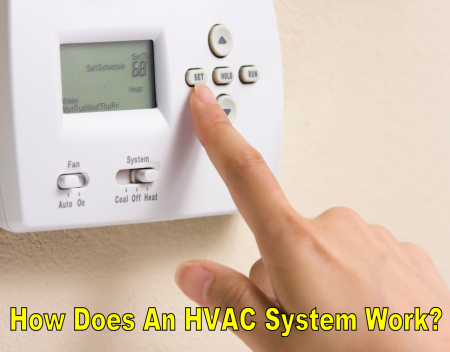
Although most homeowners may not know the inner workings of their HVAC equipment, they do know what controls the temperature in their homes, a thermostat. Even the simplest HVAC thermostat generally has an external switch for heat/off/cool, and another on/auto switch that either turns the blower fan on constantly or only when heating and cooling are running. But an electronic programmable thermostat, becoming more common in today's modern home, features multi-day settings, multi-period-per-day settings, hold, override, and even a furnace filter change reminder. Newer models are equipped with Wi-Fi ability and technology that allows you to control your thermostat using a laptop, tablet or smartphone. Best of all, a programmable thermostat can save energy by allowing you to set back your furnace or turn up your air conditioner temperature at night or when you are away.
A programmable thermostat will help to keep your HVAC system optimized. If your HVAC system is older and you are questioning its efficiency, try pairing it with a programmable thermostat to help it do its job. Reducing the workload on your HVAC equipment helps your system work at its best, and possibly extends its life.
Getting the Most Out of Your HVAC System
Besides heating, ventilation and air conditioning, there are many smaller components that make up the best HVAC systems. All of these parts are important to keeping your system working properly. An annual check-up by a qualified HVAC professional will go a long way in keeping your system at peak performance, lowering HVAC system cost over time, and ensuring your comfort and health. In the meantime, one of the simplest and most cost-effective do-it-yourself ways to maintain your HVAC system is to replace your furnace air filter on a regular basis. A fresh filter will extend the life of your HVAC unit, keep energy costs down, and, most importantly, sustain a healthy air quality.
Source: Re-posted and Summarized from Timberline.
Like most homeowners, you probably don't think a lot about your heating and air conditioning. You just want to keep warm in the winter and cool in the summer. But did you know that in the best HVAC systems your air conditioner and furnace actually work together to create a comfortable environment year-round?
How Does An HVAC System Work?
HVAC, a commonly used term in the heating and cooling industry, stands for "heating, ventilation, and air conditioning." These functions are often combined into one system in today's modern homes and buildings. The goal of an HVAC system is to provide thermal comfort and acceptable indoor air quality. All heating and cooling systems have three basic components:
1) A piece of equipment to both remove and add heat to the air,
2) A means of distributing that air throughout the home, and
3) A control device to regulate the temperature.
Both the cooled air from a central air conditioner and warmed air from the furnace often use the same distribution and control systems.
Although an HVAC system may seem complicated, breaking the system down into its components will help simplify things. Let's begin with the air conditioner.
Air Conditioning. An air conditioner makes your home cooler by drawing heat energy out of the house and transferring that heat to the outdoors through the AC system. The most common residential central air conditioner is called a "split-system." An outdoor metal cabinet (usually placed on a concrete slab next to the foundation) contains the condenser, compressor, and condenser fan; an indoor cabinet contains the evaporator. This indoor cabinet is part of the furnace that is typically adjacent to a basement wall.
The compressor pumps a heat transfer fluid, typically Freon refrigerant, between the evaporator and the condenser. The liquid refrigerant evaporates in the indoor evaporator coil, pulling heat out of indoor air. The air handler, or blower, in the furnace is used to blow the cooled air through the home duct system. When the blower turns on, it draws room air from various parts of the house through return air ducts. The air is then pulled through a filter to mitigate dust, lint, and pollutants. Air conditioners also remove moisture from the air resulting in a cool, dry home.
Heating. The furnace that is used to pump cooled air throughout your home in the summer heats your home in the winter. Whereas an air conditioner is powered by electricity, a furnace is typically fueled by natural gas. A home furnace is divided into three parts:
1) Burner, heat exchanger, vent and draft inducer
2) Safety devices and controls
3) Blower
All of these parts work together to keep the furnace running efficiently.
The heating process begins when the furnace combines air with fuel and an electronic igniter sparks the mixture. Hot gas then begins to rise through the heat exchanger positioned above the burner and heats the air which is circulated throughout the house. An electric fan situated inside the furnace pulls in air which comes through a large grill typically located on the main floor in the house or several individual grills located throughout the house. Before the air reaches the furnace, it goes through the furnace filter to remove dust and other particulate matter. The exchanger then heats the air very quickly as a result of high temperature flue gas. The hot air is forced out of the furnace and through the duct-work into your home's indoor spaces. The resulting flue gases that are used to create the heat are vented through vent piping and discharged through the outside wall or roof.
Ventilation. The best HVAC systems provide proper ventilation in your home for a comfortable and healthy environment. Ventilation is a combination of processes for exchanging or replacing air in a confined space. Natural ventilation is when air enters your home through doors, windows, skylights, etc. Mechanical ventilation, with devices such as exhaust fans, exhaust air out of your house in certain locations while fresh air enters through doors, windows and your wall. However, the HVAC system uses the air ducts to provide a balanced system of airflow throughout your home. Other more balanced ventilation system called a HRV (Heat Recovery Ventilator) or ERV (Energy Recovery Ventilator) draw in outside air and exhaust room air through a system that exchanges heat. These system are great for newer more efficient homes that have good windows, doors and insulation. The result is efficient ventilation control and oxygen replenishment, as well as removal of moisture, odors, smoke, heat, dust, airborne bacteria, carbon dioxide, and other gases.
The Thermostat Controls it All. The Brain Behind Your HVAC Equipment
Although most homeowners may not know the inner workings of their HVAC equipment, they do know what controls the temperature in their homes, a thermostat. Even the simplest HVAC thermostat generally has an external switch for heat/off/cool, and another on/auto switch that either turns the blower fan on constantly or only when heating and cooling are running. But an electronic programmable thermostat, becoming more common in today's modern home, features multi-day settings, multi-period-per-day settings, hold, override, and even a furnace filter change reminder. Newer models are equipped with Wi-Fi ability and technology that allows you to control your thermostat using a laptop, tablet or smartphone. Best of all, a programmable thermostat can save energy by allowing you to set back your furnace or turn up your air conditioner temperature at night or when you are away.
A programmable thermostat will help to keep your HVAC system optimized. If your HVAC system is older and you are questioning its efficiency, try pairing it with a programmable thermostat to help it do its job. Reducing the workload on your HVAC equipment helps your system work at its best, and possibly extends its life.
Getting the Most Out of Your HVAC System
Besides heating, ventilation and air conditioning, there are many smaller components that make up the best HVAC systems. All of these parts are important to keeping your system working properly. An annual check-up by a qualified HVAC professional will go a long way in keeping your system at peak performance, lowering HVAC system cost over time, and ensuring your comfort and health. In the meantime, one of the simplest and most cost-effective do-it-yourself ways to maintain your HVAC system is to replace your furnace air filter on a regular basis. A fresh filter will extend the life of your HVAC unit, keep energy costs down, and, most importantly, sustain a healthy air quality.
Source: Re-posted and Summarized from Timberline.
Common Washing Machine Problems
2021 Best Dishwashers By Customer Reviews

Nexgrill’s Ora Pizza Oven Provides Woodfire Flavor Anywhere
2021 Best Refrigerators By Customer Reviews
Why is my dryer taking too long to dry clothes?
Whirlpool Corporation to Feature Purposeful Appliance Innovations at IBS 2022

Why is my dryer making unusual noises?