


Appliance Types
- Air Conditioner
- Automobile
- Chainsaw
- Circular Saw
- Dishwasher
- Drills
- Dryer
- Drywall Screw Gun
- Furnace
- Gas Fireplace
- Gas Grill
- Gas Patio Heater
- Grinder
- Heat Pump
- Impact Driver
- Impact Wrench
- Microwave
- Nailer
- Orbital Sander
- Pool Heaters
- Powerwall
- Range
- Refrigerator
- Television
- Washer
- Water Heater
Appliance Brands
- A.O. Smith
- AccuCold
- Admiral Craft
- AGA
- Airrex
- Amana
- Ambiance
- American Range
- American Standard
- American Water Heaters
- Aquacal
- Armstrong
- Asko
- Avanti
- Avenlur
- Azure
- Beko
- Bellfires
- Bertazzoni
- Blackstone
- Blaze
- Blomberg
- BlueStar
- Bosch
- Bradford White
- Bromic
- Bryant
- Cafe
- Calcana
- Capital
- Carrier
- Char-Broil
- Char-Griller
- Chrysler
- Coates
- Coleman
- Comfortmaker
- Commercial Chef
- Continental
- Cosmo
- Cove
- Crown Verity
- Dacor
- Daikin
- Danby
- Danfoss
- DaVinci
- DCS
- Deco
- DeWALT
- Ducane
- Dyna-Glo
- Dyson
- EcoSmart
- Electrolux
- Element4
- Empava
- Equator
- Eurodib
- European Home
- Everdure
- Farberware
- Fhiaba
- FibroPool
- Fire Sense
- Fisher
- FiveStar
- Flare
- Flash Furniture
- Focus
- Ford
- Forno
- Forte
- Frigidaire
- Fulgor Milano
- Gaggenau
- GE
- General Motors
- GlowBrand
- Goodman
- Grundig
- GSW
- Haier
- Hayward
- Heatstar
- Heil
- Hestan
- Hisense
- Hitachi
- Hotpoint
- iio
- Ilve
- Impecca
- Ingignia
- Insignia
- JennAir
- John Wood
- Keeprite
- Kenmore
- Kenyon
- KitchenAid
- Kucht
- La Cornue
- Lennox
- LG
- Liebherr
- Lifetime
- Lion
- Luxaire
- Lynx
- Magic Chef
- Marvel
- Maytag
- McQuay
- MicroFridge
- Midea
- Miele
- Migali
- Monogram
- Montigo
- Mr Heater
- Napoleon
- Navien
- Nexgrill
- Noritz
- Panasonic
- Patio Comforts
- Payne
- Pentair
- Perlick
- PITT
- Premier
- Raypak
- Real Fyre
- Regency
- Reliance
- Rheem
- Rinnai
- Roma
- Ruud
- Saber
- Samsung
- Schwank
- Sharp
- Smeg
- Solas
- Sony
- Spartherm
- Speed Queen
- StaRite
- State Water Heaters
- Stiebel Eltron
- SubZero
- Summerset
- Summit
- SunGlo
- SunPak
- Sunpentown
- SunStar
- Superiore
- Takagi
- TCL
- TEC
- Tempstar
- Tesla
- Thermador
- Thor Kitchen
- Toshiba
- Town and Country
- Toyota
- Traeger
- Trane
- Twin Eagles
- U-Line
- Unique
- Vaillant Group
- Valor
- Verona
- Victory
- Viessmann
- Viking
- Vizio
- Weber
- Westinghouse
- Whirlpool
- Whynter
- York
- ZLINE
Article Categories
- Air Conditioners
- Appliance Care
- Appliance News
- Dishwasher News
- Drying Machines
- Furnaces
- Gas Fireplaces
- Microwaves
- Pool Heaters
- Refrigerators
- Stoves - Ranges
- Tips and Tricks
- Washing Machines
- Water Heaters
More Articles
PSC vs. ECM Motors: Know Their Differences
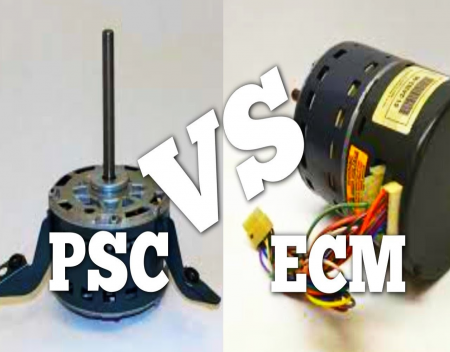
Modern electric motors are smaller, and yet more powerful, than ever before. Designers can convert electrical current to mechanical energy at sizes never thought possible, thanks to the electronics of the 20th and 21st centuries. These advancements now provide many different AC and DC motor options to choose from, which can be daunting to the uninitiated buyer. This article helps to alleviate some of this confusion by comparing two motors– the older Permanent Split Capacitor (PSC) motor and the newer Electrically Commutated (EC) motor. Both of these motors come in small sizes and provide cheap, reliable power, but this article will differentiate these two devices so that designers know which one is right for their job. First, we will start with a brief look at each motor type, and then a comparison will follow which will show the advantages of one motor over another.
ECM Motors
Electrically commutated motors, (ECMs, EC, or ECM motors), are simply a specific version of the popular brushless DC motor; it may, therefore, be useful to review this exciting new technology. To summarize, BLDC motors utilize a permanent magnet rotor and wound stator poles, and as such are "electrically" commutated (as opposed to mechanical or "brushed" commutation). The name "EC" motor is used to describe the low horsepower BLDC motors with integrated drives useful to HVAC applications. They have been separated from BLDC motors because designers do not want to confuse buyers, as the term "DC" usually refers to mechanically-commutated machines. ECMs are virtually identical to BLDC machines, except for the fact that they usually come with their own integrated microprocessor circuit that allows for speed and torque control. They are great for applications that do not have the budget for motor controllers such as variable frequency drives (VFDs) and provide all the efficiency, noise reduction, and controllability of the BLDC machine. These motors are quickly outpacing other common motors, as they are now dropping in price and can be used in hundreds of different applications.
PSC motors
Permanent-split capacitor, or PSC motors are small, inexpensive, and popularized AC motors. PSC motors are of a single-phase design, which means they are driven only by one AC current and not three offset currents. Usually, three-phase motors use three separate currents to generate a rotating magnetic field (RMF) in their stator, which will electromagnetically induce current (and therefore magnetism) in the rotor. The torque produced from the RMF on the rotor is highest when it is at rest, so three-phase motors are inherently "self-starting". Single-phase motors, while simpler in terms of their power source, cannot self-start like three-phase designs because a single phase cannot produce a true RMF.
This is where PSC motors come into play; these motors utilize a permanent capacitor in series with an auxiliary winding (also known as a starter winding) to causes part of the supply voltage to lag. By doing so, the single phase is split into two simulated phases, which can create a simulated RMF. The PSC motor is therefore an elegant design that provides the benefits of polyphase motors without the additional electrical phases and higher price point. They are reversible and perform well in low-inertia, high cycle applications such as fans and blowers. They are primarily used in HVAC applications, but they are now battling the new ECM for this spot (more on this in the next section).
Comparing ECM and PSC motors
In industry, the ECMs are starting to gain traction as an energy-efficient alternative to PSC motors, with some added benefits to boot. Table 1 shows some common characteristics between these two motors, and visualizes why designers are starting to swap out their old PSC motors for the newer, more efficient EC machines:
Since EC motors utilize micro-processing technology, they are naturally more advanced than the older PSC motor. Their design is structurally complex, as their stator contains many windings and requires accurate timing via some control module to pull the rotor around. However, this complexity is a double-edged sword; while allowing for more efficiency, less noise, and better working characteristics than PSC motors, maintenance on an EC motor takes longer and is more expensive.
The speed/torque curve of a motor defines how the motor's torque varies with RPM. PSC motors have a nonlinear torque-speed curve, which means that the torque varies widely at different speeds. EC motors provide a proportional relationship between speed and torque, which allows operators to know what the torque will be at any given speed. When paired with their speed control, this allows EC motors to change speeds and torques without much hassle, which cannot be said for the PSC motor.
The reliability of both motors is good, but the EC motor still wins in this category. The capacitors in PSC motors are prone to burning out after prolonged use which negatively affects their working lifespan. EC motors are brushless and are simple in design, lending them to long term use.
EC motors are quickly becoming the new industry standard for air handler fans and other applications because of their amazing efficiency. PSC motors dissipate heat due to their capacitors which reduces their overall efficiency to around 50%. ECMs not only uses less energy to begin with, but their microprocessor controllers can be programmed to further reduce current draw during off-peak hours as well as optimize energy usage when operating. This gives ECMs efficiencies past 90%, and the savings from using less energy can pay for the motor's higher price tag over only 1-2 years.
The dynamic response is a motor's ability to react to changes in either operator demands or applied loads. A motor with good dynamic response can change speeds quickly and can compensate for a sudden change such as increased/decreased airflow. ECMs can operate at many different speeds and, as a result, can handle variability with grace. On the other hand, PSC motors are inherently difficult to control without reducing efficiency and are sometimes referred to as "on-off" motors, as they have a tough time changing speeds. PSC motors, therefore, cannot respond as fast (or sometimes at all) to dynamic situations as can ECMs.
PSC motors produce a lot of vibrations and noise, which can deter some from using the design; however, since they are often used in fans, this is not a huge downside. The brushless design of EC motors means they are virtually silent and produce no vibrations, which is excellent for frequency-sensitive applications.
PSC motors have been the industry standard for uses in industrial furnaces, air handlers, condensers, and other packaged products for some time, which has made them both widely available and cheap. While not as programmable as EC motors, PSC motors work great in retrofit and original equipment manufacturer (OEM) applications, where designers can pick a quick and affordable PSC motor that is sure to work. ECMs are more expensive per unit but make their money back with the energy savings they produce. In short, PSC motors beat EC motors in terms of shelf price, but EC motors will save more money over time, so the choice is up to the buyer as to which motor is the cheaper option.
When it comes down to choosing the right motor, it always depends on the application. PSC motors have been successfully implemented time and time again and will provide a cost-effective means of producing rotation for HVAC applications and more. EC motors are becoming a great alternative though, providing excellent energy savings, controllability, power density, and reliability, but understand they are more complex to utilize. Always work with your supplier to research the latest motors on the market, and use the information found in this article to help find the best machine for your application.
Source: Re-posted and Summarized from Christian Cavallo at thomasnet.com.
Modern electric motors are smaller, and yet more powerful, than ever before. Designers can convert electrical current to mechanical energy at sizes never thought possible, thanks to the electronics of the 20th and 21st centuries. These advancements now provide many different AC and DC motor options to choose from, which can be daunting to the uninitiated buyer. This article helps to alleviate some of this confusion by comparing two motors– the older Permanent Split Capacitor (PSC) motor and the newer Electrically Commutated (EC) motor. Both of these motors come in small sizes and provide cheap, reliable power, but this article will differentiate these two devices so that designers know which one is right for their job. First, we will start with a brief look at each motor type, and then a comparison will follow which will show the advantages of one motor over another.
ECM Motors
Electrically commutated motors, (ECMs, EC, or ECM motors), are simply a specific version of the popular brushless DC motor; it may, therefore, be useful to review this exciting new technology. To summarize, BLDC motors utilize a permanent magnet rotor and wound stator poles, and as such are "electrically" commutated (as opposed to mechanical or "brushed" commutation). The name "EC" motor is used to describe the low horsepower BLDC motors with integrated drives useful to HVAC applications. They have been separated from BLDC motors because designers do not want to confuse buyers, as the term "DC" usually refers to mechanically-commutated machines. ECMs are virtually identical to BLDC machines, except for the fact that they usually come with their own integrated microprocessor circuit that allows for speed and torque control. They are great for applications that do not have the budget for motor controllers such as variable frequency drives (VFDs) and provide all the efficiency, noise reduction, and controllability of the BLDC machine. These motors are quickly outpacing other common motors, as they are now dropping in price and can be used in hundreds of different applications.
PSC motors
Permanent-split capacitor, or PSC motors are small, inexpensive, and popularized AC motors. PSC motors are of a single-phase design, which means they are driven only by one AC current and not three offset currents. Usually, three-phase motors use three separate currents to generate a rotating magnetic field (RMF) in their stator, which will electromagnetically induce current (and therefore magnetism) in the rotor. The torque produced from the RMF on the rotor is highest when it is at rest, so three-phase motors are inherently "self-starting". Single-phase motors, while simpler in terms of their power source, cannot self-start like three-phase designs because a single phase cannot produce a true RMF.
This is where PSC motors come into play; these motors utilize a permanent capacitor in series with an auxiliary winding (also known as a starter winding) to causes part of the supply voltage to lag. By doing so, the single phase is split into two simulated phases, which can create a simulated RMF. The PSC motor is therefore an elegant design that provides the benefits of polyphase motors without the additional electrical phases and higher price point. They are reversible and perform well in low-inertia, high cycle applications such as fans and blowers. They are primarily used in HVAC applications, but they are now battling the new ECM for this spot (more on this in the next section).
Comparing ECM and PSC motors
In industry, the ECMs are starting to gain traction as an energy-efficient alternative to PSC motors, with some added benefits to boot. Table 1 shows some common characteristics between these two motors, and visualizes why designers are starting to swap out their old PSC motors for the newer, more efficient EC machines:
Since EC motors utilize micro-processing technology, they are naturally more advanced than the older PSC motor. Their design is structurally complex, as their stator contains many windings and requires accurate timing via some control module to pull the rotor around. However, this complexity is a double-edged sword; while allowing for more efficiency, less noise, and better working characteristics than PSC motors, maintenance on an EC motor takes longer and is more expensive.
The speed/torque curve of a motor defines how the motor's torque varies with RPM. PSC motors have a nonlinear torque-speed curve, which means that the torque varies widely at different speeds. EC motors provide a proportional relationship between speed and torque, which allows operators to know what the torque will be at any given speed. When paired with their speed control, this allows EC motors to change speeds and torques without much hassle, which cannot be said for the PSC motor.
The reliability of both motors is good, but the EC motor still wins in this category. The capacitors in PSC motors are prone to burning out after prolonged use which negatively affects their working lifespan. EC motors are brushless and are simple in design, lending them to long term use.
EC motors are quickly becoming the new industry standard for air handler fans and other applications because of their amazing efficiency. PSC motors dissipate heat due to their capacitors which reduces their overall efficiency to around 50%. ECMs not only uses less energy to begin with, but their microprocessor controllers can be programmed to further reduce current draw during off-peak hours as well as optimize energy usage when operating. This gives ECMs efficiencies past 90%, and the savings from using less energy can pay for the motor's higher price tag over only 1-2 years.
The dynamic response is a motor's ability to react to changes in either operator demands or applied loads. A motor with good dynamic response can change speeds quickly and can compensate for a sudden change such as increased/decreased airflow. ECMs can operate at many different speeds and, as a result, can handle variability with grace. On the other hand, PSC motors are inherently difficult to control without reducing efficiency and are sometimes referred to as "on-off" motors, as they have a tough time changing speeds. PSC motors, therefore, cannot respond as fast (or sometimes at all) to dynamic situations as can ECMs.
PSC motors produce a lot of vibrations and noise, which can deter some from using the design; however, since they are often used in fans, this is not a huge downside. The brushless design of EC motors means they are virtually silent and produce no vibrations, which is excellent for frequency-sensitive applications.
PSC motors have been the industry standard for uses in industrial furnaces, air handlers, condensers, and other packaged products for some time, which has made them both widely available and cheap. While not as programmable as EC motors, PSC motors work great in retrofit and original equipment manufacturer (OEM) applications, where designers can pick a quick and affordable PSC motor that is sure to work. ECMs are more expensive per unit but make their money back with the energy savings they produce. In short, PSC motors beat EC motors in terms of shelf price, but EC motors will save more money over time, so the choice is up to the buyer as to which motor is the cheaper option.
When it comes down to choosing the right motor, it always depends on the application. PSC motors have been successfully implemented time and time again and will provide a cost-effective means of producing rotation for HVAC applications and more. EC motors are becoming a great alternative though, providing excellent energy savings, controllability, power density, and reliability, but understand they are more complex to utilize. Always work with your supplier to research the latest motors on the market, and use the information found in this article to help find the best machine for your application.
Source: Re-posted and Summarized from Christian Cavallo at thomasnet.com.
Dometic DrawBar novel wine cooling solution for homes with limited storage space

Induction Ranges - GE Profile PHS930YPFS vs Kitchenaid KSIS730PSS
How do I diagnose a washing machine that is leaking water?

ASKO Adds A Slew Of Distribution Partners In NA
Tools that make the difference

What makes Sub Zero fridge work better?

Dishwasher leaving crud on all my dishes

Clothes keep getting stuck in the dryer How can I stop this from happening?